Showing posts with label Robert Smithson. Show all posts

Wednesday, October 29, 2014

Walking Shots, Biked Over


Robert Smithson's concept for a floating island.

Stanley Crawford's concept for a man-made floating island. Image courtesy of http://www.stanleycrawford.net/ (buy some shallots).

Love that Smithson painted geological cross-sections.  Always found these so engrossing in text books. 

John Gerrard's Solar Reserve at Lincoln Center.  An LCD screen displaying a virtual solar power station written over a vacant expanse of Nevada desert.


Beneath the watery April sun, an occasional police car or jeep cruised slowly, watchfully, among the bright shoals of cyclists who floated, flushed, moist, openmouthed, above wantonly pumping legs, curiously disowned, jumping knees, and the transparent whir of wheels.   

-Harold Brodkey, Hofstedt and Jean--and Others, originally published in the NewYorker, 1969

 I was nearly hit by a cyclist the other day.  I was crossing 5th ave with the light and he came careening downhill with no intention of stopping.  I panicked and froze and he squeezed his brakes until his bike squealed and he popped forward on his seat. We each checked if the other was okay before we started yelling. I had the light, was my point. What if he was a car, was his point. To which I again stated, that I had the light-- this is generally less of a problem for cars. I told him he should watch where he was going and I assumed he was just as much in shock as me, because what if I had been a car? but then I grew furious with him and conceded, yes, it is true assholes who want to go fast and ignore traffic lights can drive cars or bikes. He told me to go fuck myself. I had actually just gotten off my bike. I had locked it up before crossing the street. I had the helmet tucked under my arm as I was yelling at the guy.  I was thinking about this today when my train stopped.  Strap-hanging for fifteen minutes with only the dark of the tunnel on the other side of the window, I became conscious of a fear that somehow time would figure out a way to stop-- time would stop but but my consciousness would remain active, my subway car would drop out of time, my fellow passengers would not age and would not feel time passing and though we'd all be stuck with one another, we'd remain as equally inaccessible as if the train were moving and we were waiting for the next stop. It is with biking that the frustrations of mass transit-- of being held momentarily due to the train traffic ahead, of sick passengers, of investigations and earlier incidents, of the people who look as if they've already died twice that day that stay plastered in place even though there's room in the middle and of the others who wedge themselves through the closing doors, of the basic package of powerlessness the city offers its residents--disappear.  I love riding my bike in the city.  At its best I feel as if I'm floating just eight inches above the city, which is enough to feel euphoric.  The city and its rules peel away.   The biking passages in Hofstedt and Jean-- and Others are the best I've come across for detailing the sensation of riding in the city. 


Gowanus

Irricule

Magic hour

Wednesday, June 4, 2014

Covering a Distance of 356 Feet


In the Recognitions,Wyatt Gwyon expresses the rarity of a moment of pure perception when relating his experience of seeing Night Fishing at AntibesThat scene has stuck with me and every now and then when the barometric pressure is right and I haven't over-eaten or gotten drunk, I feel clear-eyed and I think of this painting.

Sci-fi

The universe is a shadow, an absence so massive it is beguiled by the force of its own casting.   

We think of the big bang as a single event, as a moment where everything was collapsed into an infinitesimal dot.

Though I'm free to consider the possibility that the universe did not begin under the conditions of symmetry, that there were an array of bangs that cast out massive overlapping differences across the universe. 

But if I consider the single event and I think of the prospect of infinite expansion under the conditions of the laws of thermodynamics, that all matter as we know it has always existed and will always exist and will only undergo changes, I'm inclined to think of distance as the shadow of time. That is distance and time are both the vectors describing the expansion of that little dot, where the big bang is the zero state and the outer edge of the universe is its present-- we exist somewhere inside it, a dizzied mote swirling somewhere in the shadow, capable of defining a separate present.

The experience of the universe is force, matter and absence. Time and space both undergo customizations when they are attached to human experience, specializations. When we perceive time, we perceive our own mortality.  When we perceive space, we reckon our own smallness or borrow the world's largeness.  Our perceptions are attuned to radiations and emanations aged by their crossing of space. We cope with these gaps in various ways, but our senses function as relays and our experiences relay our energies. The planet is a prism, a cloud chamber, where the forces of space and time are slowed and bent by our living. We don't have to accept the indifference of the universe, we only have to understand it. 

Have you ever been to Ohio?
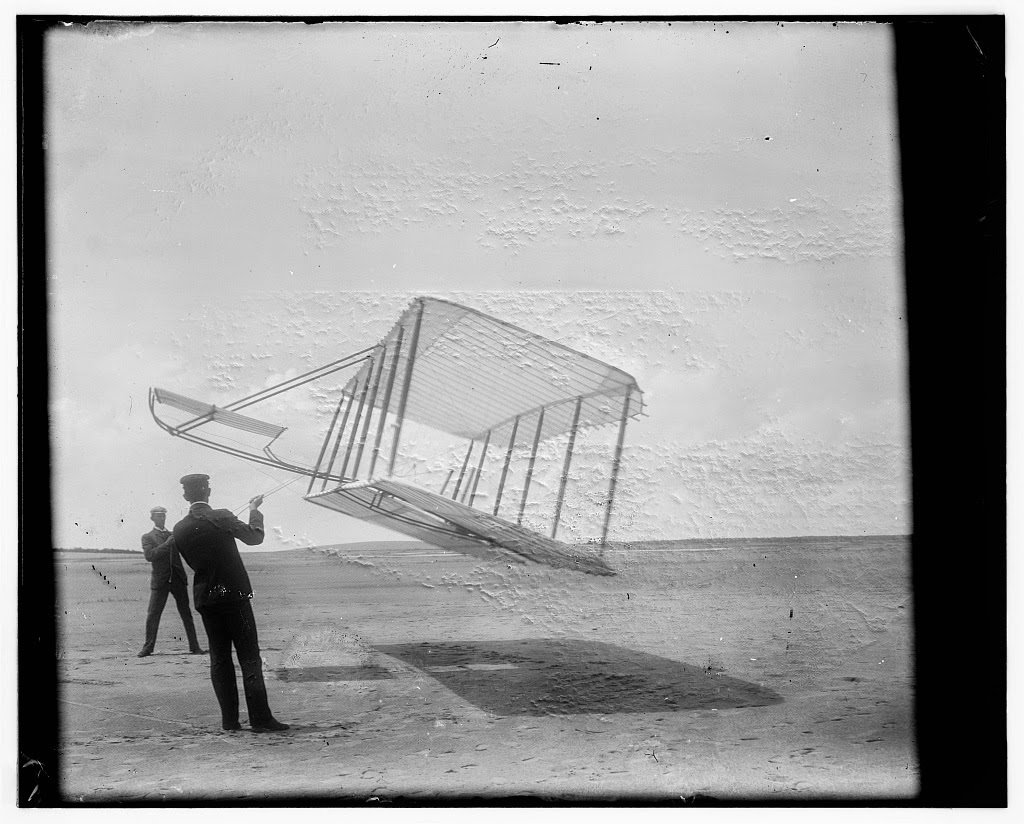
Side view of the Wright Brothers glider courtesy of the Library of Congress


Stairway Treads

At work, our stairway is covered in a black industrial tread with raised black dots to lend the treadless sole of the work-appropriate dress shoe extra grip.  Our stairway is also our fire stairway, so it serves a dual purpose and the only break in the functional repetition of the bland wall and bright rail are inspirational posters, placed at the occasion of a new floor.  If you are like me and tend to miss a step, your eye is likely pointed at the stairs for the most part and so lost inside the march of the raised black dots that cascade ever downward.  It seems like Robert Smithson's definition of a non-site, a place of pure dislocation without any identity.  Smithson, an earthworks artist, used the term pejoratively to describe the housing and commercial development booms in the late sixties and early seventies-- that continue to the present and were first signified by the mini-mall and now extend to the big box store.  But where those stores are at least partially clothed in their purpose and it can take a good half hour before I'm dwarfed by their exhaustive supply and choices, the functionality of the stairway treads overwhelm me almost immediately, to the point where I second guess taking the stairs. I feel out of place and have to stop myself from running down the stairs, even when I do, the repetition I find at the next floor is almost as disheartening as starting back at the top where I began.  There's an airlessness in the stairwell.  It's pressurized in case of fire and there's an industrial fan hidden away somewhere to suck away smoke in case it enters. For some reason today I was in the stairwell and I didn't feel the need to rush. I let the illusion that I was nowhere stand and I walked as slowly as I could and I found myself comforted by the procession of raised black dots. I let my eyes go soft and I felt for a few moments that the tread had dropped away and that I was floating down on a cushion of dots.      


Roll 'Em

A reel-to-reel projector, if turned upside down, becomes a small car. 

Portrait of Rose Covarrubias, Mexico by Edward Weston
Bad Art

One measure of bad art is the distance of the art from the artist.  Bad technique.

Another measure is the distance of the artist from the viewer.  Bad engagement.

Both measures are usually blocked by our own embarrassment because these distances come across like bad pick up lines.  We hold it against the artist because he or she could not manipulate us. 

The pleasure we take from bad art is entirely fed by our notion of the artist's shame. The artist should be shamed to make better art, but then we couldn't measure their distance from our ideal.   
     
Wax Hanks